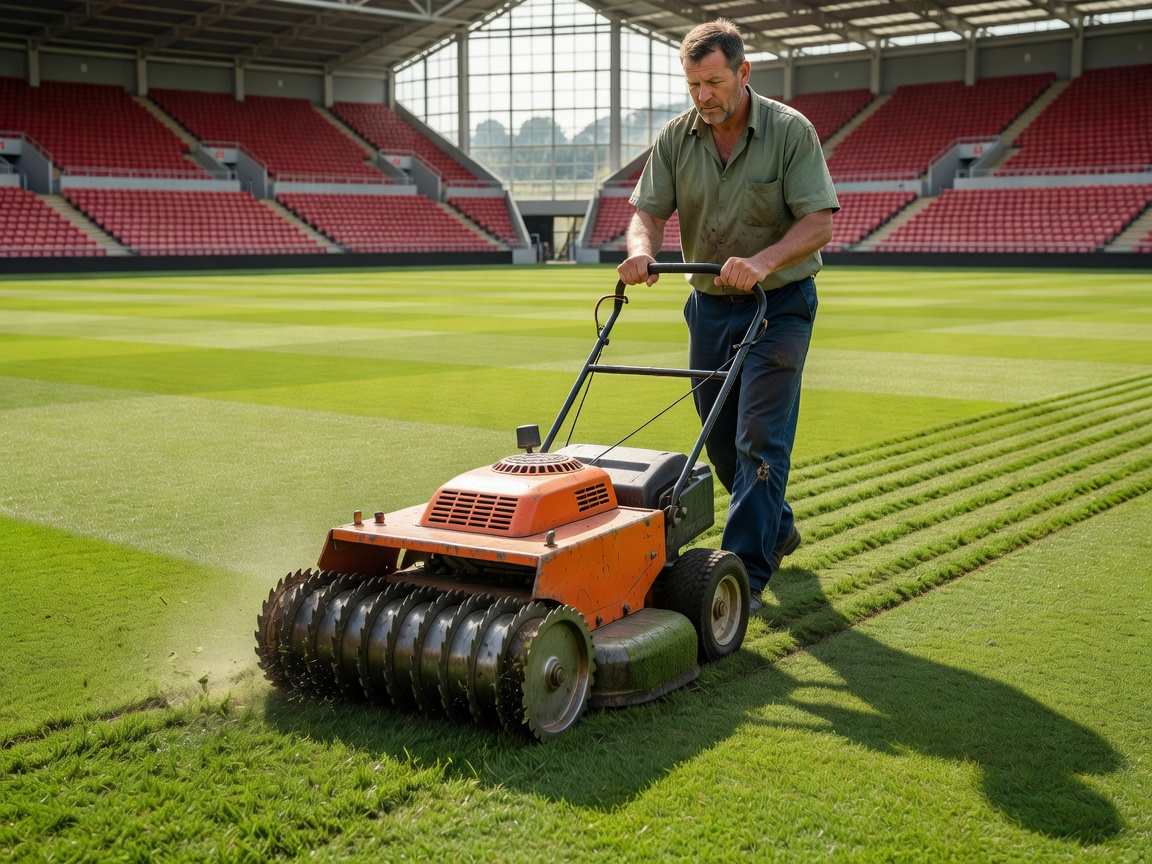
The Real Battle Is Underground
Anyone who has spent a miserable December Tuesday evening watching an over-hit backpass suddenly stop dead in three inches of greasy slurry knows that pitch upkeep is not cosmetic gardening. When players sprint, slide, and pivot with long metal studs, they transfer massive shear loads into the upper 50 millimeters of the surface. If that upper layer is rich topsoil, it packs down into an impermeable, slippery clay pan in about three weeks. That's why modern stadium pitches are built on USGA-style sand rootzones containing 85% to 90% medium-to-coarse silica sand and only a modest fraction of organic matter or peat.
Sand drains remarkably fast, but it holds almost no nutrients and has zero natural cohesion. We essentially ask grass plants—predominantly perennial ryegrass (Lolium perenne) selected for cleat wear resistance and recovery speed—to thrive in what amounts to an athletic beach. Getting that balance right takes daily attention to moisture, compaction, aeration, and nutritional spoon-feeding.
Comparing Playing Surface Technologies
Stadium managers frequently weigh whether to stick with pure natural turf, invest in hybrid reinforcement, or install fully synthetic 3G/4G systems. Each choice imposes completely distinct maintenance philosophies:
| Pitch Type | Primary Upkeep Priorities | Key Operational Advantages | Frequent Pain Points |
|---|---|---|---|
| Pure Natural Turf | Deep verti-draining, micro-coring, balanced NPK foliar feeds, hand-divoting. | Superior foot-feel, natural thermal dissipation, lowest initial capital investment. | Strict 4–6 match-hour weekly ceiling; collapses quickly under prolonged winter rain. |
| Stitched Hybrid (e.g. Polyethylene fibers) | Annual koroing (surface fraise mowing), fiber protection during verticutting. | Extreme shear strength, eliminates massive divots, allows 15–20 match hours weekly. | High machinery sensitivity (tines must not pull out fibers); high renovation cost. |
| Fully Synthetic Turf | Infill de-compaction, weekly drag-brushing, anti-bacterial wash, seam re-gluing. | Usable 40+ hours per week, immune to seasonal plant disease and frozen ground. | Surface heat retention in summer, infill migration, regular microplastic containment audits. |
Mowing Dynamics and the Cylinder vs. Rotary Question
Pitch heights are rarely set purely by managerial whim. While coaching staff might ask for 21mm for rapid ball pace or 28mm to slow down an attacking winger, the grounds team must balance that demand against root growth. The fundamental rule of turf biology is that top height dictates root depth: cut too low during short sunlight windows, and the root system retreats upwards, leaving the turf vulnerable to tearing under the first sliding tackle.
On matchday minus one, cylinder mowers are mandatory. Rotary mowers chop and rip grass tips, creating jagged leaf wounds that invite fungal pathogens like Microdochium nivale (fusarium patch). Cylinders shear cleanly like scissors, creating crisp light reflection bands that make up the iconic pitch patterns. However, right after the final whistle on matchday, rotary mowers fitted with high-suction collection boxes become invaluable: they act like giant vacuums, sucking up loose leaves, broken organic debris, and mud pills before fungal rot takes hold.
Aeration, Decompaction, and Sand Dressing
Foot traffic from 22 players plus warming-up substitutes and pre-match broadcast crews compresses the sandy profile, shrinking the macropores required for oxygen transfer and rapid water infiltration. When roots suffocate, rootzones turn anaerobic, producing that telltale black layer smelling of rotten eggs (hydrogen sulfide) which quickly kills turf roots.
A sensible maintenance calendar incorporates:
- Solid tining (Verti-draining): Driven into the profile at depths from 150mm to 250mm with a slight kicking angle to crack open subsurface compaction without tearing the top playing surface.
- Pro-Core micro-coring: Extracting narrow plugs during mid-autumn to relieve tension around intense goalmouth traffic areas.
- Topdressing with kiln-dried silica sand: Applying 60 to 100 tonnes over the season in light 3mm to 5mm dusting passes to smooth surface micro-undulations and maintain infiltration channels.
The Challenge of Stadium Microclimates
Grandstands are fantastic for atmosphere, but they are brutal on turfgrass. Modern, steep multi-tier stands create deep shade pockets across the southern third of the pitch, completely cutting off photosynthetically active radiation (PAR) between October and March. Combine that with stagnant air trapped inside high-walled bowls, and you have the ideal incubator for leaf moisture and damping-off fungal blights.
To keep grass alive under those conditions, grounds teams rely on mobile LED or high-pressure sodium lighting rigs wheeled across the pitch on pneumatic tires. These units run on 24-hour cycles to supply required light integrals. Alongside lighting, heavy horizontal circulation fans are stationed along dead-air corners to keep the leaf surface dry—because if dew sits on grass blades for more than eight continuous hours, spore germination rates skyrocket.
End-of-Season Renovation
A football pitch is essentially rebuilt every single May or June. Over ten months of competition, Poa annua (annual meadow grass) invades the ryegrass, and a layer of organic thatch builds up at the surface. In a typical renovation window of just 6 to 8 weeks, contractors use heavy surface fraise cutters (Koro machines) to cleanly scalp the top 10mm to 20mm off the surface, stripping away the thatch and weed seed bank while leaving hybrid artificial fibers intact. The pitch is then aerated, laser-graded for microscopic slope accuracy, re-seeded with elite perennial ryegrass cultivars, and fertilized to establish dense new cover before the next preseason friendly.
Need technical specifications for your pitch tender?
Whether you are moving from soil to sand-carpet or reviewing your contractor's annual aeration schedule, our team can help you review your pitch maintenance schedule without commercial bias.
Speak to Our Advisory Group