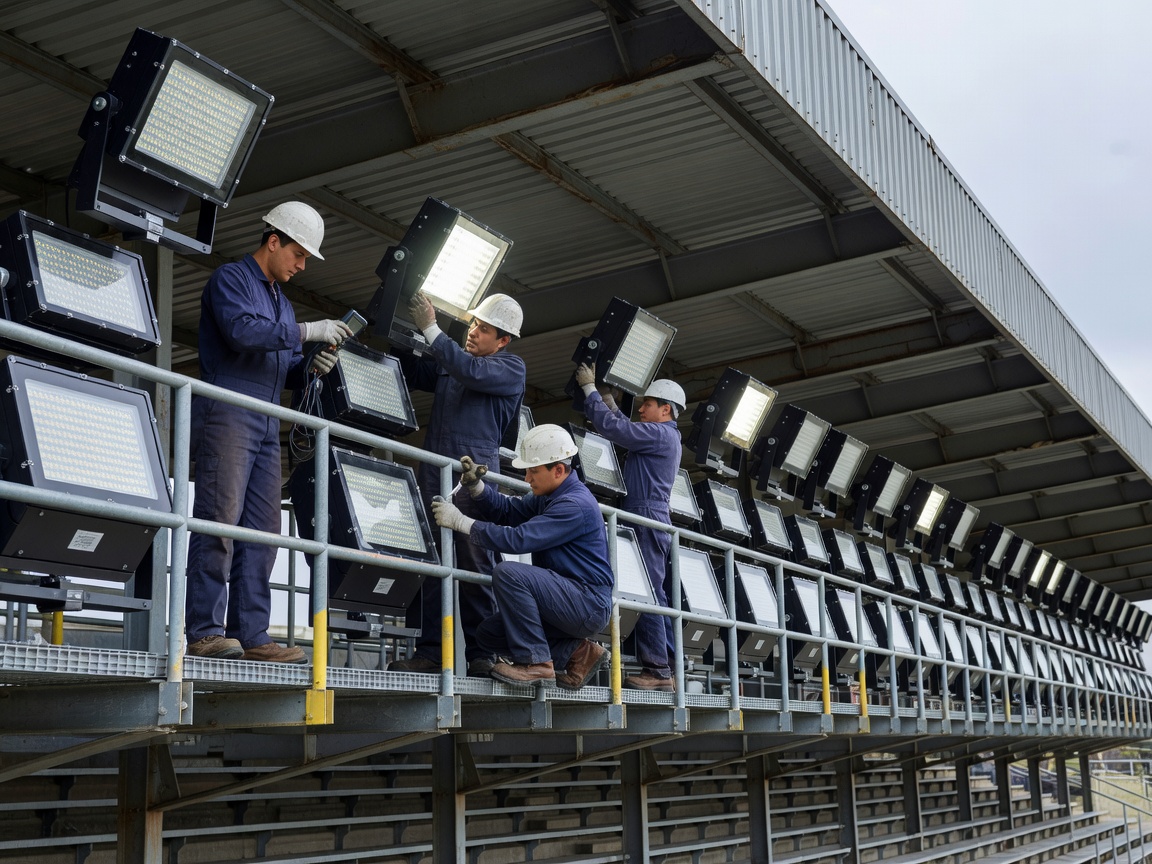
Beyond Flicking a Switch: The Electrical Heartbeat
Floodlighting is frequently taken for granted right until a breaker trips during an evening derby and plunges twenty-five thousand people into pitch darkness. In a modern football stadium, the lighting installation is a heavily engineered electro-optical instrument. It must satisfy three unforgiving audiences at the exact same moment: match officials who need clear visibility on high-speed ball flight, players who cannot afford blinding glare when looking up for a corner kick, and 4K ultra-high-definition slow-motion broadcast cameras that demand zero flicker and razor-flat color rendering.
Behind the luminaires stands a complex web of high-voltage transformers, automatic transfer switches (ATS), uninterruptible power supply (UPS) banks, and standby diesel generators. Keeping that chain reliable requires proactive electrical preventive maintenance rather than reactive fire-fighting.
Metal Halide vs Solid-State LED Arrays
Over the past decade, football has been steadily transitioning away from 2kW metal halide discharge lamps towards solid-state LED arrays. While LED systems offer enormous energy savings and instantaneous switching, their maintenance footprint is fundamentally different:
| Technology | Warm-Up / Restrike | Maintenance Reality | Primary Failure Mode |
|---|---|---|---|
| Metal Halide (HID) | 15–20 min cold warm-up; 10–15 min re-strike delay after voltage dip. | Frequent lamp relamping (approx 1,500–2,000 burning hours); ignitor and ballast box maintenance. | Electrode wear leading to color shift (pink/green hue) and ballast burnout. |
| Solid-State LED | Instant on/off (0.1 seconds); instant dynamic show programming. | Cleaning optical lenses, thermal paste/driver heat-sink monitoring, remote DMX/DALI control audits. | Driver module capacitor drying out, optical degradation due to dust/salt accumulation. |
Lux Uniformity, Flicker Factor & Aiming Grids
It is not just raw lumen output that matters; broadcast leagues mandate strict lux uniformity ratios across the pitch. A pitch might boast 1,800 lux at the center circle, but if the corners dip down to 900 lux, broadcast cameras will struggle to balance exposure during fast counter-attacks, producing grainy television footage.
Engineers calculate two key uniformity figures across a standardized 96-point or 88-point pitch grid:
- U1 (Minimum to Maximum ratio): Ensures there are no extreme bright spots or deep shadows.
- U2 (Minimum to Average ratio): Confirms overall surface consistency across both horizontal (pitch turf) and vertical planes (facing cameras at 1.5m height).
- Flicker Factor (FF): Broadcast slow-motion cameras recording at 300+ frames per second will capture cyclic pulsing if LED drivers do not deliver ultra-smooth direct current (DC). Routine testing with high-speed photometers is essential.
If heavy winter gales knock mast gantry brackets just three degrees out of alignment, the carefully calibrated lighting grid collapses. Laser alignment tools are used during annual reviews to re-aim every individual head back to its designated coordinates on the turf.
Dual Supplies and Generator Switchover Discipline
A premier venue cannot operate on a single grid connection. Standard practice entails dual-feed grid substations supplemented by on-site diesel generators. However, the critical link is the automatic transfer switch (ATS). When mains grid voltage fluctuates or drops, the system must detect the anomaly and cut over to backup power within milliseconds.
For stadium engineers, "it worked when installed" is not a maintenance plan. Generator regimes should involve:
- Weekly no-load runs: Confirming starter battery voltage, engine block heating, and fuel line pressure.
- Monthly full-load resistive bank testing: Bringing the diesel engine up to 80%–100% capacity to prevent "wet stacking" (unburnt fuel buildup in the exhaust) and verifying governor stability under peak demand.
- Synchronized live black-start tests: Manually dropping the grid supply during off-weeks while the stadium lighting is fully energized to ensure the UPS seamlessly holds the control logic while generators pick up the gantry loads without luminaire drop-out.
High-Mast and Roof Gantry Structural Inspections
Whether lights are mounted on four towering 45-meter corner pylons or slung from the cantilevered roof rafters, the structural integrity of those steel assemblies is a serious life-safety consideration. Vibration induced by wind vortex shedding can loosen fastening bolts or induce fatigue cracks in bracket welds.
Every two to three years, certified rope-access engineers or cherry-picker teams should inspect mast flanges, lightning dissipation rods, earth bonding continuity, and cable support trays. Water ingress into high-mast junction boxes remains the single most common cause of nuisance RCD tripping during torrential autumn downpours.
Planning an LED retrofit or lighting survey?
We help venue teams evaluate lighting replacement tenders, draft broadcast compliance criteria, and set up foolproof generator exercise schedules.
Request Electrical Engineering Advice